This article is for informational purposes only and does not constitute legal advice. Immigration law is complex and country-specific. Always consult a qualified immigration lawyer before making decisions.
Ireland isn’t the easiest country to immigrate to. It’s also one of the most accessible. It depends entirely on where you’re starting from. Most people who decide on Ireland hit the same wall shortly after making that decision: the country itself is an easy sell. The immigration system is considerably less so.
Ireland is mystical place that lives in the dreams of many people. It’s real though … a real place with real problems, and it might not be right for your family (check out this article for more info). If you’ve done your research and know this is where you belong, the next step is figuring out your legal path in.
In this article we’re doing a full walkthrough of every realistic path to Irish citizenship by descent and beyond. Visas. Naturalization. Entrepreneurship. And the big one — Irish citizenship by descent through the Foreign Births Registry. If you have Irish roots, you’ll want to pay attention to that last one.
It’s important to note that Irish citizenship is more than a passport. It’s full access to the European Union; the legal right to live, work, start a business, and access healthcare in any of 27 countries. It’s access to the UK via the Common Travel Area (check out this article for more info on this unique perk). And for a lot of people, it’s a chance to reconnect with family roots in a country that actually values peace and stability.
That’s the prize. Worth keeping in mind as we walk through the sometimes-tedious mechanics.
There are several ways into Irish citizenship, and they are not all equal. Some require you to physically relocate. Some require a specific family connection. Some require both. By the end of this article, you’ll know which door is yours … or if one is even open at all.
Let’s get into it.
The Honest Truth About Irish Immigration
Before we get to the good stuff, it’s worth being honest about something. Ireland is not an easy country to immigrate to if you’re starting from scratch.
There’s no points-based system like Canada. No digital nomad visa like Portugal or Spain. If you’re a non-EEA citizen and you want to build legal footing in Ireland without a family connection or an ancestral claim, your options are there … but they’re narrow.However, before you can set up a life in Ireland, you need to understand the steps and degrees of permission along the path towards citizenship.
- Level 1: The Tourist. Most people reading this article can visit Ireland for 3 months without needing any kind of visa (for simplicity we won’t include the new e-visas the EU rolled out in 2026. They work differently than residence visas). You visit the country, drink some Guinness, explore for a little while, then go home. Pretty simple.
- Level 2: The Resident. If you want to reside in Ireland, you’ll need a resident visa. There are several different types and each has it’s own set of application criteria and privileges. These visas are good for a set length of time (usually 2-3 years) and have to be renewed. More on visa types in a moment.
- Level 3: The Permanent Resident. This is a stage that is reached after you’ve been a legal resident for a set length of time (usually 5 years). Once you meet the requirements, you apply for PR and, once granted, it allows you to live in Ireland for an indefinite timeline. It’s worth noting that most people opt to pursue Citizenship instead of PR since if you’re eligible for PR, you’re usually eligible for citizenship too and that’s the bigger prize.
- Level 4: Citizenship. This is the ultimate stage and grants full privileges to work, live, and vote in Ireland for life. As a citizen you’d also have an Irish passport. Usually, one can apply for citizenship after 3-5 years of full time, legal residence.
Great. Now you understand the degrees of permission you’ll encounter along your journey. But how do we start? How do we secure that first visa to get our foot in the door and start setting up a life in Ireland? Let’s dive in!
Irish Immigration Through Work
The main work route is called the Critical Skills Employment Permit. This grants a Stamp 1 visa and is Ireland’s primary visa for skilled foreign workers … the keyword is skilled. We’re talking about occupations on a government-defined list. Technology, engineering, healthcare, finance. It’s employer-sponsored, which means you need a job offer from an Irish company before you can apply. Not impossible, but this is not a casual path.
There’s also the General Employment Permit for roles outside the Critical Skills list, but this route is more restrictive, comes with quota limitations, and is harder to navigate without already being embedded in the Irish job market.
There’s one more work-based route worth mentioning for any founders in the room: the Start-up Entrepreneur Programme (STEP). Ireland’s pathway for non-EEA founders who want to build a business in-country. You need a genuinely innovative, internationally scalable business idea, at least €50k in funding, and a credible plan for job creation in Ireland. A committee reviews applications quarterly. This is a high bar, but for the right person it could rapidly open the door to the coveted Stamp 4 Irish residence visa and eventual citizenship (we have a full deep-dive coming in a future article in this series).
Irish Immigration Through Education
Ireland has world class education at every level and many people decide to attend university in Ireland. If this is/was you, this section is for you. Study in Ireland is governed by Stamp 2; the student residence permit for non-EEA nationals enrolled in a full-time course (note that the course chosen must be on the government’s approved list). In addition to studies, Stamp 2 allows you to work up to 20 hours per week during term and 40 hours during designated holidays.
Here’s the important thing to know upfront: Stamp 2 time does not count toward naturalization. Those years in Ireland are legally frozen for citizenship purposes. If you complete a degree in Dublin and assume that time is already in the bank — it isn’t.
The path forward runs through the Third Level Graduate Scheme. When you finish your degree, you can apply to stay in Ireland on a Stamp 1G to find employment. This visa gives you 12 months for a level 8 degree (think bachelor’s level) or 24 months for a masters or PhD graduate. Time spent on Stamp 1G visa does count toward naturalization.
From there, if you secure a qualifying job in Ireland, you move onto a Stamp 1 or Stamp 4 visa and start building your five reckonable years in earnest (don’t worry, more on this momentarily).
So the honest picture: education can be a legitimate on-ramp to Irish residency and eventual citizenship … but it’s a long runway. You’re not counting years from day one of your degree. The clock starts when you transition into graduate or employment status. Factor that into your timeline before you commit to this path.
Irish Immigration Through Family Connections
If you have an Irish spouse or civil partner, the picture changes considerably. A qualifying spousal relationship opens the door to a family reunification visa. This visa type grants unrestricted rights to live and work in Ireland without an employment permit, and that time counts toward naturalization. Even better, as the spouse of an Irish citizen, you can naturalize after just three years of residence. A very straightforward path if this applies to you.
If your Irish ancestry includes an Irish born parent or grandparent, you have an even cleaner path to citizenship. If your parent is Irish born, you’re already a citizen! You just need to register and request a passport. If your connection is through an Irish born grandparent, you can register via the Foreign Births Registry (FBR). A slower process but equally accessible. Through either path, you can gain citizenship and a passport without any time spent living in Ireland. More on these paths in a minute.
Special Mentions
- Stamp 0: This route I want to flag specifically because people get caught by it. Stamp 0 is Ireland’s long-stay permission for retirees and people of independent means. It sounds appealing on paper but this visa doesn’t lead to citizenship or permanent residency. Time on Stamp 0 does not count as reckonable residence toward naturalization. You can live there and enjoy the country — but you cannot earn a citizenshiprc on it. If an Irish passport is your goal, Stamp 0 is a dead end. Know that before you build a plan around it.
- The CTA: This is a genuinely interesting quirk of Irish/UK law left over from their shared history. A citizen of either country can legally reside in the other. This means a British citizen could legally move to Ireland without a visa, set up legal residence, and start counting time to naturalization. Not a path open to a large percentage of people but if this is you … congrats!
Visa Type Summary
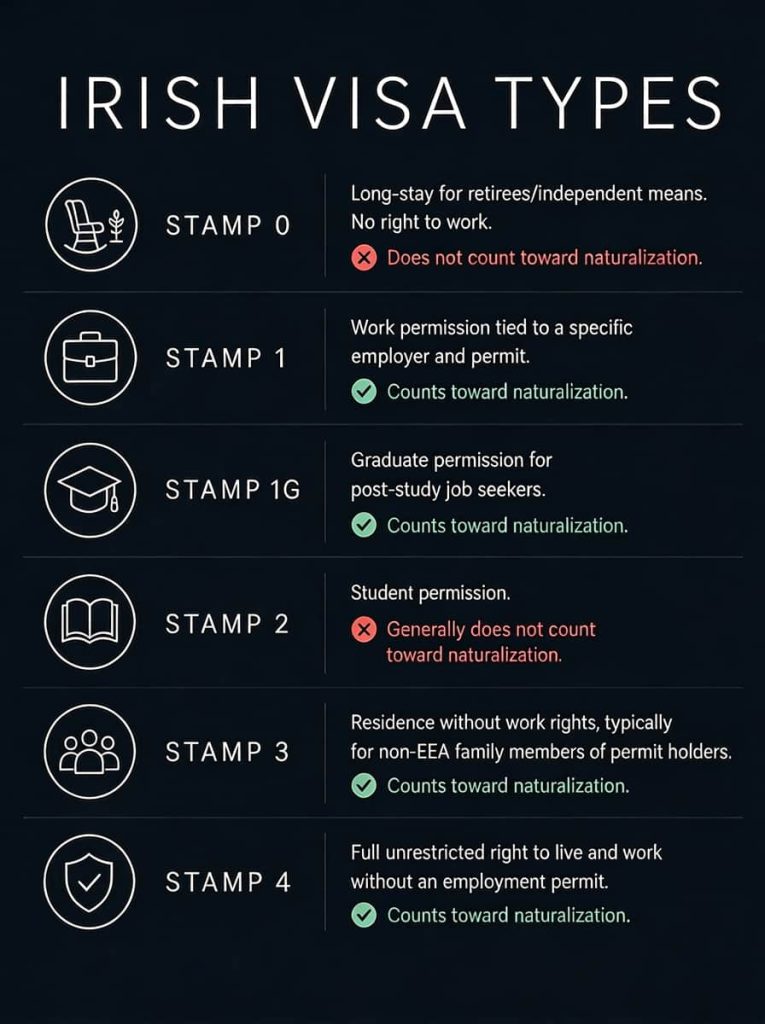
Here’s a quick summary of what each stamp actually means for your path forward:
- Stamp 0 — Long-stay for retirees/independent means. No right to work. Does not count toward naturalization.
- Stamp 1 — Work permission tied to a specific employer and permit. Counts toward naturalization.
- Stamp 1G — Graduate permission for post-study job seekers. Counts toward naturalization.
- Stamp 2 — Student permission. Generally does not count toward naturalization.
- Stamp 3 — Residence without work rights, typically for non-EEA family members of permit holders. Counts toward naturalization.
- Stamp 4 — Full unrestricted right to live and work without an employment permit. Counts toward naturalization. The stamp to aim for.
If you have Irish roots, the picture changes entirely; we’ll talk about that in a minute. First though, let’s work through the path a normal person takes to achieve Irish citizenship.
Naturalization: The Long Game
Ok, so you’ve confirmed you don’t have Irish ancestors (if you do, don’t worry, the next section will be for you). But, you’re undeterred, have your visa lined up, and are ready to work towards citizenship. Naturalization is your path. This is the path for people who want to earn Irish citizenship through residency. You move there, build a life, and eventually Ireland recognizes you as one of its own.
Unlike Irish citizenship by descent, the core requirement for naturlization is five years of reckonable residence — legal, registered time in Ireland — including at least one continuous year immediately before you apply.
Reckonable is the word worth paying attention to. Not all time in Ireland counts equally. Stamp 1, 3, 4, or 5 — you’re building toward your five years. Stamp 2 (student visa) generally doesn’t count. Stamp 0, as covered above, doesn’t count at all.
Here’s something most people miss and it’s one of the more generous aspects of how Ireland structures this: the five years don’t have to be consecutive. It’s five years out of the previous nine. You could have lived in Ireland for a few years, left, come back, and as long as you can account for five calendar years of reckonable residence within that nine-year window, plus that clean continuous final year, you’re eligible. That’s a far more flexible structure than most countries offer.
The continuous final year is a hard requirement though. Up to 70 days of explained absences are permitted; work travel, family emergencies, that kind of thing. But don’t plan on spending extended periods abroad and expect it to count.
One more thing that surprises most people: there’s no language test. No civics exam. For a country with a national language that isn’t English, that’s notable. You prove your residency, demonstrate good character, and apply. That’s genuinely it. (Though personally, I think anyone pursuing citizenship in a country should make a good faith effort to learn its language — at least the basics. Gaeilge is worth the effort.)
Current processing time runs around 19 months from application to decision. Not quick. But predictable, and if your residency record is clean, the outcome isn’t really in doubt.
If your spouse or civil partner is an Irish citizen, the five-year requirement drops to three. The marriage doesn’t hand you a passport — Ireland doesn’t work that way — but it shortens the timeline significantly.
Naturalization is the long game. But for people who genuinely want to live in Ireland, it’s a reliable, well-defined road to one of the best passports in the world.
Irish Citizenship by Descent: the Foreign Births Registry
This is the part most people with Irish roots came for.
The Foreign Births Registry (FBR) is Ireland’s mechanism for people born outside Ireland to claim citizenship through ancestry. And the framing here matters.
The FBR is not a visa. It’s not a residency permit. It’s not even really an application in the traditional sense — it’s a registration. What you’re doing when you file with the Foreign Births Registry is proving that you are already eligible to be an Irish citizen. The citizenship rights already exist. You’re just documenting them.
This is meaningfully different from something like naturalization, where the Minister has what’s called absolute discretion — meaning approval isn’t guaranteed. The FBR isn’t like that. If you can prove the bloodline, approval is a legal obligation. You either qualify for Irish citizenship by descent … or you don’t. If you do, Ireland must recognize your claim. You’re not asking for a discretionary favor. You’re claiming something that’s already yours by law.
Which Scenario Are You?
Rather than walking through this as a legal framework, here’s a simple decision tree. Three scenarios — figure out which one you’re in, and everything else follows.
Scenario A — Your parent was born in Ireland.
Stop here. You don’t need to research Irish citizenship by descent … you’re already an Irish citizen! You don’t need the FBR at all. Go straight to the passport application.
Scenario B — Your grandparent was born in Ireland, and your parent was born outside Ireland.
This is the most common scenario for people abroad with Irish roots. You apply to the Foreign Births Registry directly. Your parent doesn’t need to do anything themselves — the claim runs from you, through your parent as the middle generation, back to your Irish-born grandparent.
The Irish government does require documents relating to your parent as that middle generation. If your parent is living, you’ll need a certified copy of their photo ID — a driver’s license is most common. A notary works for most Americans, but a lawyer, teacher, or other professional on the DFA’s recognized witness list can certify it too. If your parent is deceased, their death certificate replaces that requirement.
The Irish birth is what creates the claim. You can’t skip a generation on any other basis.
Scenario C — Your parent was registered on the FBR before you were born.
This is the scenario that allows the citizenship chain to extend beyond two generations … and probably the least understood of the three.
If your parent went through the FBR process and was entered onto the register before you were born, they became an Irish citizen through that registration. Which means at the time of your birth, you had an Irish citizen parent. Which means you qualify for the FBR yourself — regardless of how many generations back the original Irish connection goes.
The timing is everything. Your parent must have been registered before you were born. If they registered after your birth, that registration doesn’t reach back. Your path in that case is naturalization, not the FBR.
A Concrete Example
Let’s make this real with a fictional family. The Murphys.
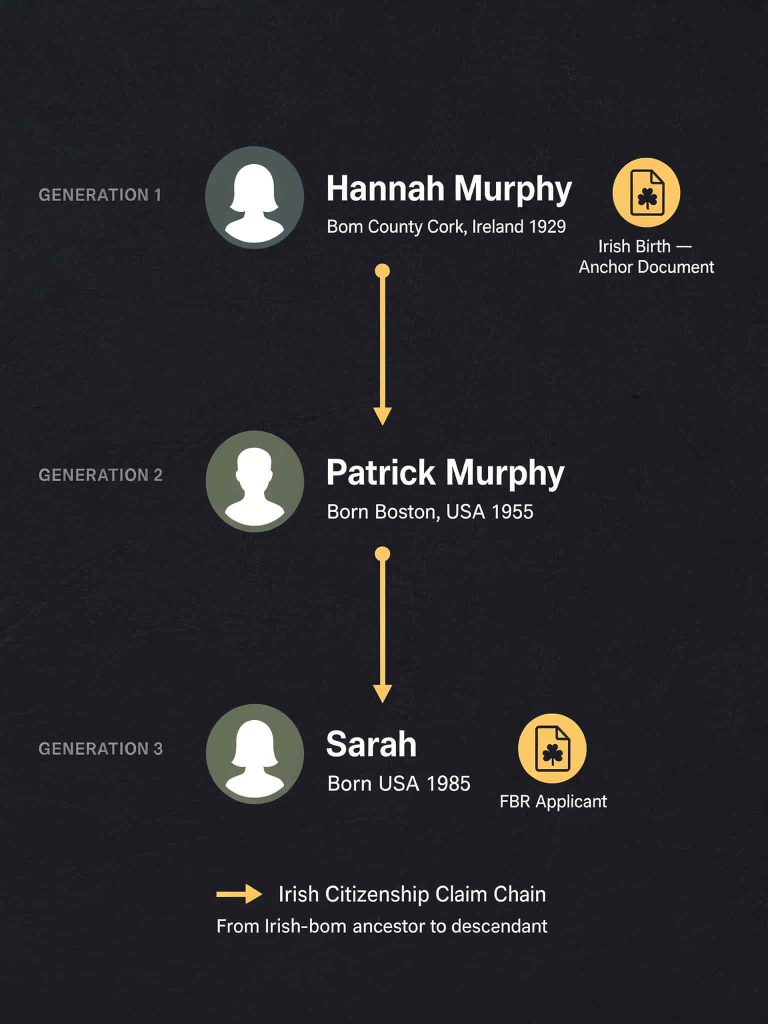
Hannah Murphy was born in County Cork in 1929. She emigrated to the United States in 1951, married an American, and had a son — Patrick — born in Boston in 1955. Patrick had a daughter, Sarah, born in 1985. Sarah is reading this article.
Hannah is the anchor. Born in Ireland. That’s the birth that creates the claim.
Patrick was born in Boston, never looked into any of this, never registered anything. He’s alive, living in Florida.
Sarah is in Scenario B. Her grandparent was born in Ireland. Her parent was born outside Ireland and has never registered. Sarah applies to the FBR directly. Patrick doesn’t need to do anything — but the Irish government needs to account for his identity as the middle generation. Since he’s living, Sarah needs a certified copy of his driver’s license.
Sarah gathers Hannah’s Irish birth certificate and U.S. marriage certificate documenting her name change. She collects Patrick’s birth certificate and her own. She submits the full package to the Foreign Births Registration Unit in Dublin. If the documents are in order — she gains Irish citizenship by descent.
That’s the chain. Birth cert, marriage cert, birth cert, marriage cert, birth cert. Each link documented. Each name change accounted for. The goal at every step is simply proving an unbroken line back to an Irish citizen.
The Documentary Chain
The documents you need — birth certificates, marriage certificates, death certificates — are a full topic on their own. There’s a dedicated article coming in this series that walks through the entire document chain step by step: what to order, where to order it, how to handle missing records and name variations, and how to put the package together before you mail it to Dublin.
For now: it’s more manageable than it looks. Most documents either already exist in free online databases or can be ordered by mail for a small fee. The research is the work. The paperwork is mostly just waiting for envelopes to arrive
The FBR Process: What to Expect
You know if you qualify. You know what you need to gather. Here’s how the actual application works.
The process starts online at dfa.ie. You complete the FBR application form digitally, pay the fee — €278 for adults, €153 for anyone under 18 — then print the completed form, sign it in front of your witness, and mail the full package to the Foreign Births Registration Unit in Dublin. I personally recommend sending it via DHL — reliable and cheaper than most alternatives.
Once Dublin receives your complete package, the clock starts. Current processing time is running around 10–12 months. Applications are handled in strict date order. You won’t receive regular status updates. You may not hear anything for months — that’s completely normal. Resist the urge to ask for updates.
If they need something from you during processing, they’ll reach out. Otherwise, the next contact will be their final decision.
Assuming success, you’ll receive a Foreign Birth Registration Certificate. That’s your proof of Irish citizenship, returned along with all your original documents.
From there, you apply for your Irish passport separately — the two applications are handled by different offices and cannot be submitted simultaneously. Once you have the certificate in hand, the passport application is straightforward. Standard process, ten-year validity for adults.
One important note for expectant parents: If you’re currently in the middle of an FBR application and expecting a child, contact the FBR customer service hub directly. There’s an expedited process for exactly this scenario. The DFA has a mechanism for it. Use it.
The Bottom Line
Visas, naturalization, the CTA, the Foreign Births Registry/Irish citizenship by descent. Every realistic door into Irish citizenship. People walk through each of these doors every year; through work, through education, through family connections, through ancestry. Most couldn’t be described as easy, but they aren’t out of reach either.
The honest truth is that eligibility rarely ends up being the limiting factor. Most people who could qualify for an Irish citizenship pathway — through any route — never pursue it. Don’t let that be you! Too often the difference between the people who end up with an Irish passport and those who don’t is less about eligibility and more about gumption.
You now know which door is yours. That’s further than most people ever get.
What you do with that knowledge is the only variable left. And remember: what’s on the other side of the work isn’t just a passport, it’s a legal home somewhere else. Options that most of your peers will never have. The private knowledge that if something changes, you’re not cornered. That’s worth a little effort:)
Next in this series: The FBR document chain.
Exactly what to order, where to get it, and how to build a complete application package.